






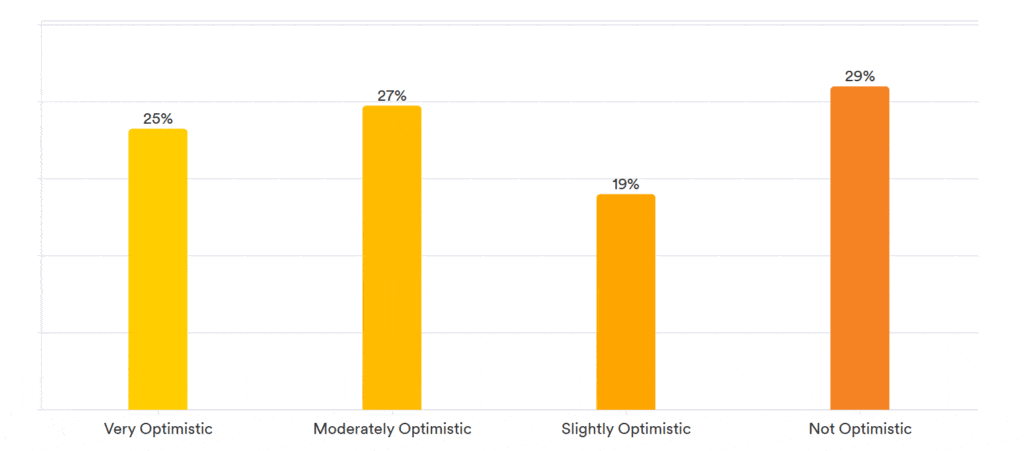
The February LANDTHINK Pulse revealed that 27% of respondents are MODERATELY OPTIMISTIC for the ag economy in 2026, while 25% of respondents are VERY OPTIMISTIC and 19% are SLIGHTLY OPTIMISTIC. As decreased selling prices and rising expenses continue to have a detrimental effect on the earnings of farmers cultivating row crops like corn and soybeans, the U.S. agriculture sector is beginning to falter. Due to rising prices for agricultural commodities worldwide, the agriculture industry was doing well in 2022. Since then, decreased prices for the four most produced commodities in the United States and rising production and shipping expenses have resulted in a decline in farmers’ profitability.
Last month, the February Pulse asked: How optimistic are you for the ag economy in 2026?
The United States Department of Agriculture (USDA’s) latest farm income forecast delivers the first estimates for 2026 while also significantly revising its outlook for 2025. Due to last year’s government shutdown, the USDA did not release its customary December farm income update, and many economists have been waiting since September for new predictions and farm revenue statistics. This February report marks the first update since September, and the changes are substantial. USDA now estimates that 2025 net farm income totaled about $154.6 billion, down roughly $25 billion from the $179.8 billion forecast in September. Net cash farm income for 2025 was similarly revised down to about $153.9 billion, nearly $27 billion below the $180.7 billion previously projected. The report essentially said that 2025 was worse than previously estimated. The 2026 forecast shows modest stabilization of the farm economy, but government farm payments will likely be playing an increasingly central role in profitability as financial stress indicators persist.
Ag Trends Framing 2026 and Beyond
1. Government payments continue to drive farm income in 2025 and 2026.
Government payments remain a key factor in USDA’s farm income outlook. USDA now estimates direct government payments totaled $30.5 billion in 2025. USDA forecasts direct government payments will rise to $44.3 billion in 2026, an increase of $13.8 billion from the revised 2025 level. Supplemental and ad hoc disaster assistance payments are forecast at $23.9 billion in 2026, driven largely by remaining Supplemental Disaster Relief Program (SDRP) payments that were not distributed in 2025 and Farmer Bridge Assistance Program disbursements at the end of February.
Due to changes to Agriculture Risk Coverage and Price Loss Coverage permitted under the One Big Beautiful Bill Act, farm bill payments that are triggered when commodity prices decline are projected to be $15.2 billion, up $13.1 billion from 2025. While conservation payments are anticipated to reach $5.3 billion, up $219 million from the previous year, dairy margin coverage payments are projected to reach $122.9 million, up from 2025.
The farm income rebound was government-funded, not market-driven. This is a telling signal for farmland and agriculture investors, since it shoes how much of the sector’s cash flow may be supported by programs rather than just commodities profits. These payments, which are linked to food security and the nation’s capacity to maintain production resilience during economic cycles, act as a stabilizing function during times of stress and market disruption.
2. Higher interest rates and tight credit are a central, challenging reality.
This has created a “liquidity crisis” for many operations, particularly in the crop sector. The high interest rates are severely compressing farm profit margins, increasing costs for land, equipment, and operating inputs.
The emphasis is now on debt structure, payback alignment, and liquidity management. In a tighter credit climate, producers are better positioned to preserve flexibility and lessen marginal pressure if they closely monitor their balance sheet and comprehend how loan terms interact with seasonal cash flow.
3. Financial pressure varies based on commodity type and operation.
Financial pressure varies significantly among farmers, with the highest stress concentrated on younger operators, those with high debt-to-asset ratios, and producers renting most of their land. There are significant financial disparities based on commodity type, farm size, and operator experience.
- Young farmers are facing severe financial strain due to a combination of high interest rates and the prevalence of variable-rate loans.
- Livestock producers have seen stronger performance driven by high animal product prices, although cattle producers still face risks if prices correct.
- Row-crop producers are facing acute pressure due to a 42-58% decline in commodity prices from 2022 highs, combined with high, persistent production costs.
- Diversifying farm operations in 2026 is a critical strategy for struggling producers to manage high input costs, thin margins, and market volatility. By expanding into new crops, livestock, or value-added services, farmers can reduce reliance on a single income stream, boost financial stability, and improve resilience against climate or trade shocks.
4. Farmland values are stabilizing, after years of rapid growth.
The stabilization provides a crucial buffer for farmers facing compressed margins, lower commodity prices, and high interest rates. Land equity (both as asset ownership and equitable access) is essential for farmers to survive by providing financial security, enabling access to credit, and ensuring long-term stability.
While land equity can solve short-term cash flow problems by converting illiquid land value into working capital, it does not inherently solve long-term profitability issues and can increase financial risk if not managed correctly.
5. Solid producers are turning to diversification and creativity
The most resilient farm operations are ensuring survival by blending creative, regenerative practices, such as using organic waste as mulch and managing soil health, with deep community relationships, including direct-to-consumer marketing, transparent farming, and shared stewardship models. By embracing sustainable and resource-efficient practices such as regenerative agriculture, many are creating more resilient, sustainable, and profitable agricultural businesses.
Most farmers plan to weather 2026 prioritize high liquidity, manage tight margins through strict cost control, and diversify income streams to withstand low commodity prices and high input costs. Even though economists says the U.S. farm economy is experiencing a significant, sustained strain, the welcome surprise has been the resilience of land values. Farmland supply has continued to be historically low, yet demand has remained stable. For farmers who own their land outright, the resiliency of the market is what’s keeping many of them in business with negative profit margins.
Do you have a suggestion for next month’s Pulse question? Submit your question and we might choose yours!
This content may not be used or reproduced in any manner whatsoever, in part or in whole, without written permission of LANDTHINK. Use of this content without permission is a violation of federal copyright law. The articles, posts, comments, opinions and information provided by LANDTHINK are for informational and research purposes only and DOES NOT substitute or coincide with the advice of an attorney, accountant, real estate broker or any other licensed real estate professional. LANDTHINK strongly advises visitors and readers to seek their own professional guidance and advice related to buying, investing in or selling real estate.



Add Comment