







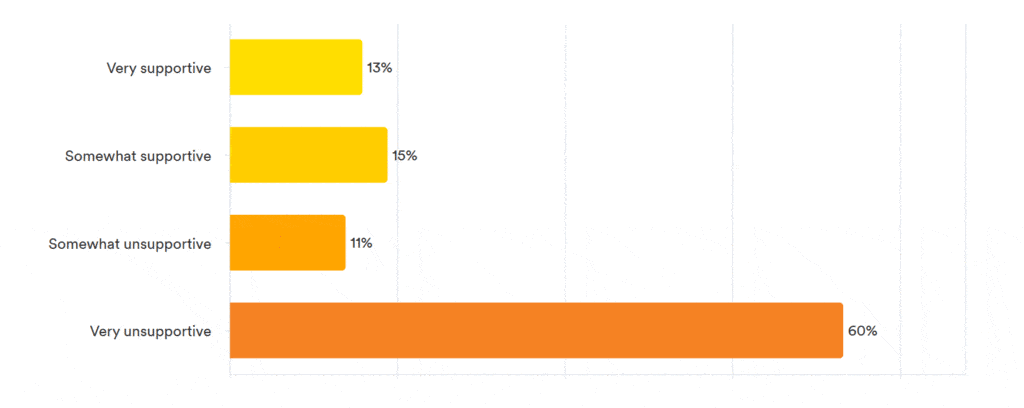
According to the December LANDTHINK Pulse results, an overwhelming 60% of respondents said they are VERY UNSUPPORTIVE of data center construction being allowed in rural areas, with 11% indicating they were SOMEWHAT UNSUPPORTIVE. Only 13% of respondents said they were VERY SUPPORTIVE of data centers being build in rural areas. Data centers have been around for years, but the demand skyrocketed in the last few years due to generative artificial intelligence (AI) tools like ChatGPT becoming available to the public. The explosion of artificial intelligence applications and growing appetite for data is creating massive demand for data center space like never before. Data centers house the digital files that underpin AI, cryptocurrencies, cloud computing, self-driving tractors and a host of other emerging technologies.
Last month, the December Pulse asked: Given the vast amount of water, energy, and real estate resources data centers use, are you supportive of them being allowed in rural America?
Rural communities are now emerging as prime locations, not to create jobs and increase a community’s economy, but because of low costs, availability and affordability of land, and generous tax breaks. At least 37 states offer incentives ranging from sales and use tax exemptions to property tax abatements, often tied to minimum investment thresholds and job creation requirements. States with the biggest tax breaks for data centers include Virginia, Illinois, Georgia, Iowa, and Nevada, which offer massive exemptions on sales, use, and property taxes.
Rural counties across America are starting to push back on data center development, despite promises of economic benefits. Data centers are resource-ravenous, and are quietly straining the resources of rural communities. Small towns in places like Georgia and Virginia are grappling with water stress, power demands, and environmental risks.
Data centers are one of the most energy-intensive types of buildings, consuming 10 to 50 times the energy per floor space of a typical commercial office building. Cooling rows of server stacks is a massive driver of electricity consumption, often accounting for 30% to 50% of total data center power usage. A conventional data center draws as much electricity as 10,000 to 25,000 households, according to the International Energy Agency. But a newer, AI-focused “hyperscale” data center can use as much power as 100,000 homes or more.
In addition to their energy needs, data centers require water for evaporative cooling systems that keep servers from overheating. Mid-sized data centers consume as much water as a small town, while larger ones can guzzle up as much as 5 million gallons of water a day, the equivalent usage of a town with 50,000 people. Data centers that power AI applications need even more water. Researchers were able to calculate that ChatGPT “drinks” roughly 500 ml of fresh water for every 20 to 50 questions that it answers. That’s the same as a 16.9 oz water bottle.
Data center land acquisition is a rapidly growing concern. Earth has a finite amount of land, and the available surface area shrinks with every new piece of infrastructure built. The total land requirements for modern hyperscale campuses often exceed 200 to 500 acres, but in strategic regions, campuses are crossing the 800 to 1,000-acre threshold to future-proof operations for decades. That’s hundreds of acres of land that will no longer be available for farmland, nature, or housing, and will require new transmission line corridors and other associated infrastructure as well.
Large AI-driven data center projects are now facing intense resistance from rural communities driven largely by increasingly unaffordable electricity bills, environmental pollution concerns, and the potential loss of their community’s rural character. States with high concentrations of data centers, such as Virginia, Illinois, and Ohio, have seen electric bills rise significantly faster than the national average. The new infrastructure data centers require as well as ongoing grid maintenance and upgrades, are typically shared by all electric customers in a service area. Lawmakers are also starting to worry that the pace of data-center growth and the amount of land and resources being devoted to it has gone too far.
Research collected by Data Center Watch shows at least 16 data center projects, worth a combined $64 billion, have been blocked or delayed as local opposition mounts to the developments. Lawmakers in several states are exploring passing laws that would put statewide bans in place on building new data centers.
Georgia is quickly becoming ground zero in the fight. A state lawmaker has introduced a bill proposing what could become the first statewide moratorium on new data centers in America. The Georgia bill seeks to halt all such projects until March of next year. But datacenter concerns in Georgia also include water use and lost tax revenue. Republicans in the state legislature have introduced bills this year to protect consumers from increases in their utility bills and to end tax breaks for the centers.
The Trump administration and a consortium of governors from northeastern states are asking PJM Interconnection, LLC, (PJM), the country’s largest electrical grid operator, to hold an emergency power auction as part of an effort to make technology giants pay for surging power costs from new data centers. Trump wrote in a Truth Social post that he was working with tech companies on policies that would help them grow without raising costs for ratepayers. “I never want Americans to pay higher Electricity bills because of data centers,” Trump wrote.
Data centers are increasingly targeting rural communities with promises of economic development, high-tech job creation, and increased tax revenue, but these pledges are often found to be exaggerated, resulting in significant risks to local resources and infrastructure. Studies show data centers create very few long-term, permanent jobs. While developers promise tax revenue, they often negotiate large tax incentives, leaving residents to worry about the long-term financial risks if the companies leave or the technology becomes obsolete.
However, there is still a fundamental conflict: Data centers have to go somewhere. Life would come to a standstill if data centers were to suddenly disappear. Consider this: Americans send and receive over 2 trillion text messages annually, 88% of U.S. households subscribe to a streaming service, every new automobile has some form of connectivity and 89% of Americans use mobile banking.
As digitalization accelerates, sustainable infrastructure has become more than a regulatory requirement. For investors and business leaders, championing the shift toward sustainable data centers presents both an opportunity and a responsibility. Looking ahead to the 2030s and beyond, emerging technologies are poised to revolutionize how data centers operate sustainably.
Do you have a suggestion for next month’s Pulse question? Submit your question and we might choose yours!
This content may not be used or reproduced in any manner whatsoever, in part or in whole, without written permission of LANDTHINK. Use of this content without permission is a violation of federal copyright law. The articles, posts, comments, opinions and information provided by LANDTHINK are for informational and research purposes only and DOES NOT substitute or coincide with the advice of an attorney, accountant, real estate broker or any other licensed real estate professional. LANDTHINK strongly advises visitors and readers to seek their own professional guidance and advice related to buying, investing in or selling real estate.




Add Comment