





Last month, the LANDTHINK Pulse posed the following question to our audience: What do you see as the greatest threat to the future of agricultural land ownership in America?
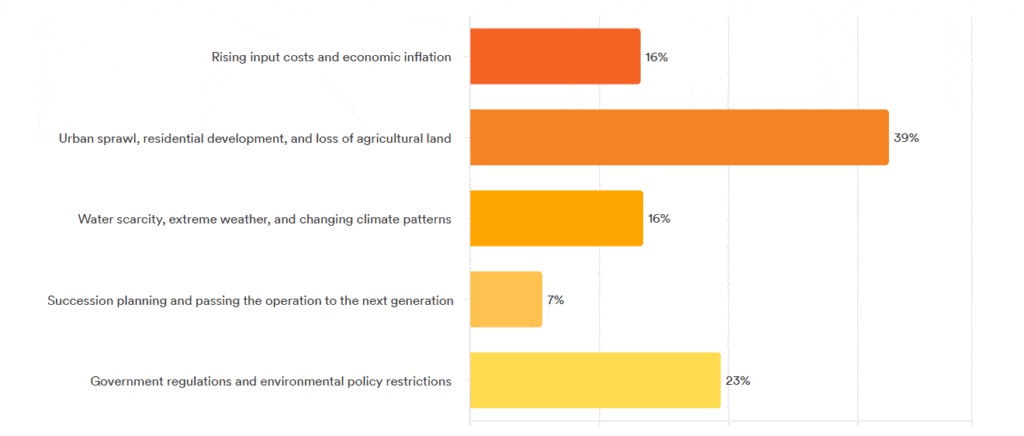
America’s farmland is an irreplaceable commodity. The United States is blessed with a remarkably productive agricultural landscape. Cropland, pastureland, rangeland, and timberland support a regionally diverse food and farming system capable of ensuring the country’s food supply in tumultuous times. However, every day, the amount of fertile farmland diminishes as development spreads. According to the American Farmland Trust (AFT), the U.S. is losing forty acres of farm and ranch land every hour to new development. This means about 3 acres of farmland is lost every minute. Since 1982, America has converted 24 million acres of agricultural land to developed uses. Our informal online survey revealed that 39% of respondents view urban sprawl, residential development, and loss of agricultural land as the greatest threat to the future of agricultural land ownership in America, with government regulations and environmental policy restrictions (23%), coming in a close second.
Agricultural land continues to be absorbed by urban sprawl to accommodate commercial, residential, and industrial growth. While traditional urban expansion primarily converts cropland, low-density residential development affects both cropland and pastures equally.
Increasing non-residential development like the rapid proliferation of utility-scale solar facilities also contributes to loss of farmland, as these facilities favor high-quality farmland since it’s typically flat, dry, cleared and close to existing infrastructure. An AFT report on solar development modeling stated over 2 million agricultural acres are projected for conversion to solar development between 2020 and 2040. Of that, nearly half is expected to occur on land AFT deems “nationally significant” due to high levels of productivity, versatility, and resiliency.
Urban sprawl and residential development drive up the cost of farmland by creating fierce competition for land and inflating its market value based on future development potential rather than agricultural productivity. The intense competition for land effectively prices young and beginning farmers out of the market.
How Sprawl Drives Up Farmland Costs
Anticipated Development Premiums: Land prices near expanding cities reflect the “development component” – the present value of future profits if the land becomes a subdivision or commercial center, making it too expensive for pure agricultural use.
Competing Land Uses: Real estate developers, commercial strip malls, and housing subdivisions “bid up” the price of acreage at the urban fringe, pricing out traditional farmers.
Increased Property Taxes: As neighboring areas urbanize and land assessments rise to reflect non-agricultural market values, farmers face soaring property taxes that make farming financially non-viable.
Landscape Fragmentation: Low-density residential sprawl breaks farming regions into disconnected parcels. This disrupts local agricultural supply chains, pushing out equipment dealers, grain elevators, and specialized labor, which further devalues the operational efficiency of remaining farms.
Coming in a close second, 23% said government regulations and environmental policy restrictions the greatest threat to the future of agricultural land ownership. Courts and litigation are shaping farm policy and creating steep burdens for American farmers and ranchers. Federal overreach, overbearing regulations that lower affordability, and increasing compliance costs have made farming more difficult.
Government regulations and environmental policies can inadvertently threaten the future of family-owned farmland by inflating operating costs, restricting how property can be used, and complicating land succession. While these rules are often intended to protect natural resources or ensure national security, their real-world economic impacts can make traditional farming financially unsustainable. This frequently pressures families into selling their acreage to corporate developers or institutional investors.
Key Environmental Regulations and Policies Threatening Ag Land Ownership
1. Land-Use Restrictions and “Regulatory Takings”
When environmental policies restrict how a farmer can use their own land, it can result in a “regulatory taking”. While the government does not physically seize the land, the regulation strips it of its economic value.
Wetlands and “Swampbuster” Rules: Under federal conservation compliance (like the United States Department of Agriculture Swampbuster provision), farmers can lose vital agricultural benefits or face heavy penalties if they clear, drain, or farm on designated wetlands. High-profile legal battles have challenged these rules, with landowners arguing that blocking development on small parcels of private wetlands effectively drives the land’s value down to zero.
Waters of the United States (WOTUS): Ongoing jurisdictional shifts over what qualifies as a federally protected waterway under the Clean Water Act create immense legal uncertainty. Farmers worry that temporary ditches, ponds, or dry creek beds on their property could suddenly fall under federal authority, requiring costly permits for routine farming practices like plowing or building drainage networks.
2. The Endangered Species Act (ESA)
The presence of a protected or endangered species on private farmland can lead to severe restrictions on land management. Landowners may be barred from clearing brush, changing crops, or utilizing specific water resources. Because the ESA often shifts the financial burden of conservation entirely onto the landowner, critics argue it turns ecological stewardship into a financial liability.
3. Chemical and Pesticide Restrictions
Environmental mandates targeting pesticide and fertilizer runoff heavily dictate daily farm operations. Federal debates over “pesticide preemption” provisions – which dictate whether state and local governments can enforce chemical safety rules that are stricter than federal standards – leave many farmers vulnerable to shifting local zoning restrictions and multi-million dollar nuisance lawsuits.
4. Eminent Domain and Green Energy Infrastructure
The Green Energy Push: Environmental mandates driving the transition toward renewable energy have created massive demand for solar and wind farms. Developers often target prime farmland for these projects.
Forced Seizures: In some cases, agricultural land faces seizure through eminent domain to build interstate utility pipelines or water infrastructure. This risk has become severe enough that lawmakers have proposed the Not In My Barnyard Act to make prime agricultural land the absolute last resort for government infrastructure projects.
The future of farming and food security depends on keeping farmers on the land and preventing reckless development that prioritizes profit over community and food sustainability. Farmland is not just about producing food; it’s about keeping the ecosystem balanced, preserving local economies, and ensuring a secure food supply for future generations. When land is lost to development, it’s lost forever.
As populations grow and development pressures increase, many communities are recognizing the importance of protecting agricultural land. Through conservation programs, responsible land-use planning, impact assessments, redevelopment initiatives, and support for new farmers, communities have a range of tools available to help safeguard the future of agricultural land ownership.
Do you have a suggestion for next month’s Pulse question? Submit your question and we might choose yours!
This content may not be used or reproduced in any manner whatsoever, in part or in whole, without written permission of LANDTHINK. Use of this content without permission is a violation of federal copyright law. The articles, posts, comments, opinions and information provided by LANDTHINK are for informational and research purposes only and DOES NOT substitute or coincide with the advice of an attorney, accountant, real estate broker or any other licensed real estate professional. LANDTHINK strongly advises visitors and readers to seek their own professional guidance and advice related to buying, investing in or selling real estate.


Add Comment