



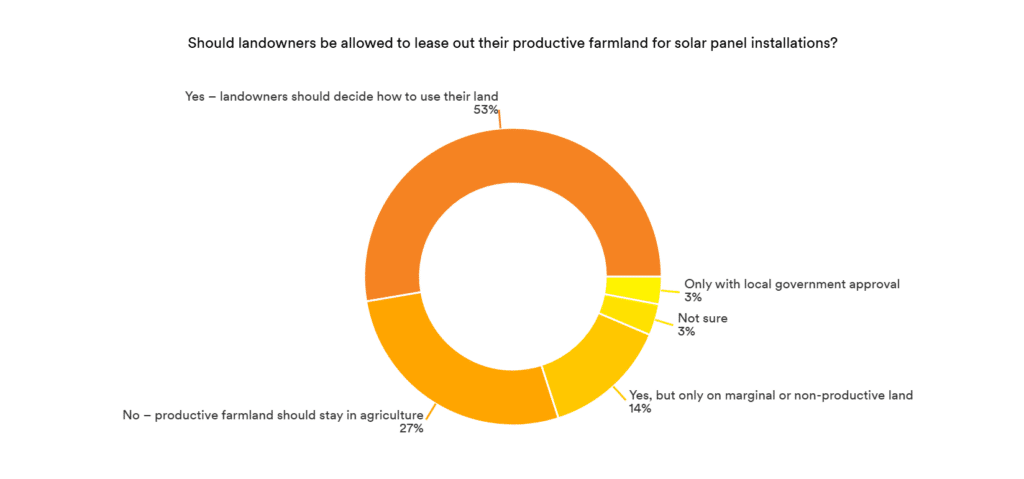
Last month, the LANDTHINK Pulse posed the following question to our audience: Should landowners be allowed to lease out their productive farmland for solar panel installations?
Our informal online survey revealed that 53% of respondents feel that farmers should be allowed to lease their private, productive farmland to solar developers – landowners should decide how to use their land. The agricultural community is increasingly exploring solar energy development as a strategic addition to traditional farming operations. Farmers facing financial difficulties surmount the volatile crop prices and rising expenses by leasing their farmland to solar developers. Leasing fertile cropland to solar companies can bring in enough revenue to keep the farm in the family, a better alternative than selling the property to developers.
The U.S. Department of Agriculture (USDA) projects net farm income will slip lower in 2026 and remain roughly $48 billion (24%) below the record highs reached in 2022. The losses are especially severe for major row crop producers. Recent data shows that farmers growing corn, soybeans, and wheat have lost an average of about $300 per acre over the past three years. Cotton producers have faced even steeper losses, averaging roughly $1,000 per acre during that same time period.
Roughly two-thirds of producers continue to expect their net farm income to decline in 2026 due to the Iran War, which has resulted in increased fuel and fertilizer costs.
Over the past five years, farm expenses have averaged approximately 111 percent of farm income, meaning many producers are spending more than they earn just to continue operating. Production costs have increased by roughly 33 percent during that time, further tightening already narrow profit margins.
To keep their farms running, many producers must borrow large amounts of money each season to cover upfront expenses. These financial risks can accumulate quickly when crop prices fail to cover production costs, leaving farmers deeper in debt year after year.
Faced with razor-thin margins and falling crop yields, many farmers are stabilizing their income by leasing land for solar development.
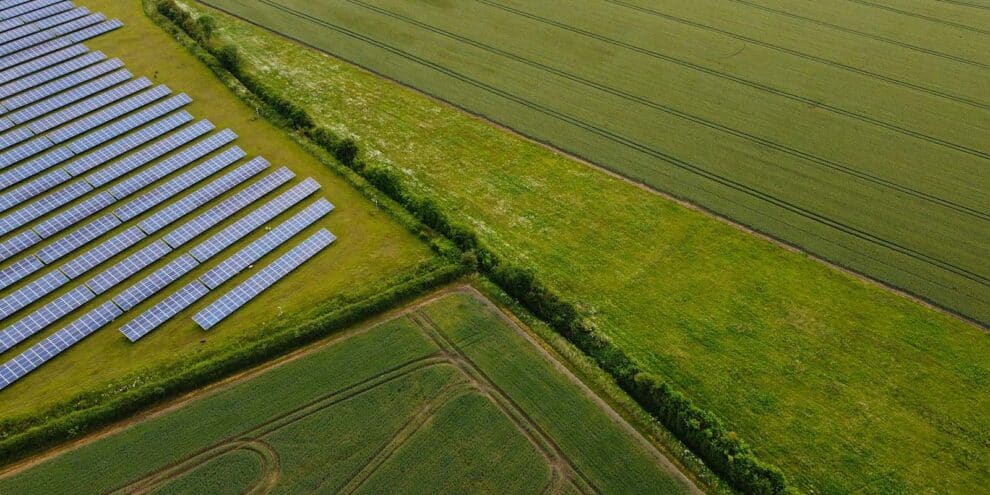
According to the U.S. Department of Agriculture (USDA) census, over 116,000 U.S. farm operations have solar panels installed on their property and about 1.25 million acres of farmland have been converted for solar use. Prime agricultural land is popular for solar installations, partially because it’s often open, dry, and relatively flat. Construction costs for solar conversion on farmland are generally lower than on other types of ground.
Leasing privately owned farmland to solar developers is a legal land-use option that offers immense benefits but requires navigating complex, multi-decade contracts.
Potential Benefits for Farmers
Leasing land for large-scale solar facilities can offer several advantages to landowners:
- Revenue Generation: It provides a steady source of income, often more predictable than traditional crop yields
- No Cost: In most instances, there is absolutely no cost for solar development on farmland.
- No Maintenance: Upkeep for the solar farm and supporting land is entirely the solar developer’s responsibility. Solar generating equipment, landscaping, and accompanying electrical gear are all handled by the solar developer.
- Keeps Farms in the Family: Guaranteed lease income helps farmers avoid selling their property for permanent commercial or residential development.
- Economic Diversification: Solar leases represent a unique investment capable of generating multiple streams of income and acting as a hedge against inflation.
- Environmental Stewardship: Large-scale solar contributes to renewable resource development, offering both tangible environmental and intangible community benefits.
- Increased Land Value: Some industry data suggests that long-term leases can somewhat increase the overall value of the land.
- Dual-Use Farming (Agrivoltaics): Farmers can still use the land beneath and between panels for livestock grazing (like sheep), pollinator habitats, and shade-tolerant crops.
Key Concerns and Challenges
Despite the benefits, several critical concerns are frequently raised by opponents, the community and industry experts:
- Loss of Prime Farmland: Large arrays remove top-tier soil from traditional agricultural production, which impacts regional food supply chains and local agricultural economies.
- Property Values: Some participants question whether the presence of large-scale solar farms reduces the value of neighboring properties.
- Community Comfort/Aesthetic Backlash: Potential buyers and residents may have varying comfort levels living near industrial-scale solar developments, which can change the character of rural areas, leading to community tension and sometimes local zoning bans.
- Corporate Agendas: Expert consultants note that solar companies often approach landowners with their own specific agendas, making education and professional guidance crucial for the landowner.
- Long-Term Contract Risks: Farmers are locking their land into 20- to 40-year agreements. If the solar developer defaults or goes bankrupt, landowners can be left with abandoned equipment and cleanup liabilities.
- Barriers to New Farmers: The conversion of farmland into solar sites can drive up land costs, making it harder for younger or new farmers to access the affordable, quality land they need to get started.
Agrivoltaics is a game-changing solution to land-use conflicts by allowing solar energy generation and agriculture to share the exact same plot of land. This innovative approach has gained significant attention in recent years, as it attempts to solve multiple problems at once. It uses the shaded space underneath solar panels to grow crops. It eliminates the “food versus fuel” debate, keeps productive land active. This increases land-use efficiency, as it lets solar farms and agriculture share ground, rather than making them compete against one another. And certain crops appear to thrive when grown in such environments, according to a number of recent studies.
While imagery of the American Dream used to be picturesque farm towns, values have shifted, and once-robust farming communities have become forgotten lands, with few farmers left in sight.
As generational and economic values collide, farmers are weighing their agricultural heritage against the rising demand for renewable energy. While solar leases offer financial security and diversification, many grapple with parting from traditional multi-generational farming.
Younger farmers prioritize quality of life, sustainability, and flexibility, which often creates friction with older generations who value traditional stability and hands-on work. This shift in values forces families into tough choices over whether to sell land, modernize operations, or exit farming entirely. No matter how you look at it, embracing solar development makes sense for farmers. With the right approach, solar farms can provide significant benefits to farmers and agricultural communities.
To avoid unexpected surprises and be prepared for the future, it is always advisable to consult an attorney to ensure your interests are fully protected.
Do you have a suggestion for next month’s Pulse question? Submit your question and we might choose yours!
This content may not be used or reproduced in any manner whatsoever, in part or in whole, without written permission of LANDTHINK. Use of this content without permission is a violation of federal copyright law. The articles, posts, comments, opinions and information provided by LANDTHINK are for informational and research purposes only and DOES NOT substitute or coincide with the advice of an attorney, accountant, real estate broker or any other licensed real estate professional. LANDTHINK strongly advises visitors and readers to seek their own professional guidance and advice related to buying, investing in or selling real estate.

As long as a farmer and the solar provider can absolutely ensure that the runoff from degrading panels – heavy metals, etc., will not leech into the groundwater for nearby farms? Yes? But we know the answer to that.