






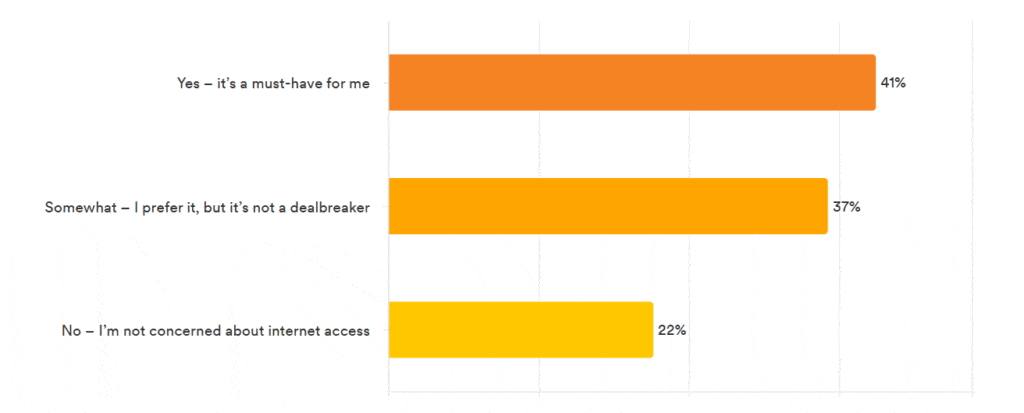
Last month, the LANDTHINK Pulse posed the following question to our audience: Would the availability of high-speed internet influence your decision about where to buy land?
Our informal online survey revealed that 37% of our audience feel that while the availability of high-speed internet is preferred, it would not affect their decision about where to buy land and 22% said they were NOT CONCERNED about internet access when making a decision on where to buy land. For 41% of respondents, high-speed internet is a must-have when buying land.
You find a great, remote piece of land on LANDFLIP. The property checks all the boxes. The price is manageable. It has deeded access and the hunting is great. Then it hits you: is high-speed internet access available there? For many land buyers, the availability of high-speed internet is one of the easiest things to overlook and one of the hardest things to fix after closing. Internet affects property resale value, remote work capability, home-schooling, security cameras, map access, streaming and other daily conveniences, and even whether a future home or weekend retreat is doable day to day. On rural land, high-speed internet access isn’t something you can assume is available within the county or a nearby town. Verifying internet access before buying rural property is vital. While a lack of high-speed broadband was once an absolute deal-breaker, it is no longer a strict deterrent for many buyers of rural land due to modern satellite and cellular alternatives.
Why Connectivity Matters
Property Value: Land and homes with verified high-speed broadband command a measurable price premium over disconnected plots.
Remote Work & Income: A reliable connection is required if you plan to work from home, run a farm business, or manage an online enterprise,
Safety & Security: Modern security cameras, smart gates, and remote environmental monitors need stable bandwidth to function.
Daily Living: Access to telehealth, remote education, and general banking depends heavily on a strong network.
Travel Planning: You need dependable maps, weather updates, and route changes.
Future Improvements: A cabin, shed conversion, or RV pad is easier to plan when you know your internet path.
As a practical rule, you should view internet connectivity in the same way you look at access and zoning. Although it might not be the primary feature that draws you to a parcel, it can absolutely determine whether the property aligns with your actual goals.
The Best Rural Internet Options
Satellite Internet: Satellite service is available virtually everywhere in the United States, requiring only a clear view of the sky.
- Starlink: This is the top choice for performance, utilizing low-Earth orbit (LEO) satellites to offer fast speeds (50–400 Mbps) and low latency. It is responsive enough for video calls and online gaming, though upfront equipment costs are high.
- Hughesnet & Viasat: These providers use traditional, high-altitude geostationary satellites. They offer nationwide availability but suffer from higher latency (lag) and stricter data thresholds.
Traditional Satellite: Traditional satellite internet uses a single fixed Geostationary Earth Orbit (GEO) satellite positioned about 22,000 miles above the equator to beam wireless internet signals between a ground station and a home satellite dish. It offers wide rural availability but suffers from high latency and weather disruptions.
Fixed Wireless Internet: Fixed wireless Internet is a great option for rural areas that provide broadband speeds without cables or phone lines. This technology uses local topography and radio signals to transmit Internet data between an Internet service provider’s (ISP) access point and a small antenna installed at your home. When it works, it can feel surprisingly solid. But it depends heavily on line of sight. In areas with significant geographical obstacles, such as mountains, dense forests or ridges, performance may suffer or service may not be available at all.
Digital Subscriber Line Internet (DSL): DSL is high-speed Internet access that uses existing copper telephone lines from homes and businesses to transmit data. This type of high-speed Internet requires a DSL modem, unless your computer already has an internal modem (frequently called a voiceband modem). As a broadband option, DSL is always on, unlike a traditional dial-up connection. DSL can still provide sufficient speeds for most online activities, such as browsing, streaming, and video calls.
Cellular Home Internet and Hotspots: Cellular-based internet can work well when the parcel has strong service from one or more carriers. It is a viable option for rural areas, but performance depends heavily on your local cell signal strength, distance to the nearest tower, and data caps.
Internet Access and Rural Real Estate Values
Studies consistently show that high-speed internet access positively influences rural property and land values. Improved broadband availability boosts agricultural profitability, increases residential property premiums, and elevates both farmland sale prices and cash rental rates. Properties with access to reliable high-speed internet command measurable premiums over comparable properties without it. If a buyer is looking at two farms that are about the same size and in similar shape, the one with a solid internet connection definitely has the upper hand because of how much more you can do with it right away. It can support a home office, precision agriculture equipment, remote monitoring for livestock, smart irrigation systems, and a family’s entertainment and education needs. The property without reliable connectivity forces compromises that many modern buyers simply are not willing to make.
Critical Due Diligence for Buyers
Before closing on a rural tract, experts recommend a thorough assessment of the “digital infrastructure”.
- Verify Service Availability: Never assume “power at the road” means internet is easily accessible. Check with multiple providers for verified service availability at the specific parcel.
- Estimate Extension Costs: If fiber is nearby but not at the property line, obtain concrete cost estimates for extension, as these can be unexpectedly high.
- Future-Proofing: Consider how evolving technology and local zoning might affect your ability to run a home-based business or build a permanent home office.
Buying a remote farm or ranch without high-speed internet works if you value quiet and space. If your goal is purely recreational (e.g., hunting, fishing) and you value total isolation, lack of internet may not be a dealbreaker. However, if you intend to resell, work remotely, or build a primary residence, a lack of connectivity infrastructure should be considered a significant liability that may limit your pool of future buyers and negatively impact property appreciation. You must weigh the peaceful lifestyle against the high cost and stress of missing a fast connection.
Do you have a suggestion for next month’s Pulse question? Submit your question and we might choose yours!
This content may not be used or reproduced in any manner whatsoever, in part or in whole, without written permission of LANDTHINK. Use of this content without permission is a violation of federal copyright law. The articles, posts, comments, opinions and information provided by LANDTHINK are for informational and research purposes only and DOES NOT substitute or coincide with the advice of an attorney, accountant, real estate broker or any other licensed real estate professional. LANDTHINK strongly advises visitors and readers to seek their own professional guidance and advice related to buying, investing in or selling real estate.



Add Comment